Reimagining L&D Platforms
Effective Skill Building in Large Organisations
Detailed UX Solution
Comprehensive UX
Duration
8 Weeks
Industry
Enterprise learning, upskilling, and talent development within large organizations
My Role
As the Lead UX Designer, I was responsible for the end-to-end design process, from initial research to final prototype
Led user research sessions with 24 employees across multiple teams
Facilitated design workshops with stakeholders and subject matter experts
Created wireframes, prototypes, and high-fidelity designs
Conducted usability testing and iterated based on feedback
Brief
Explore current learning experiences in large organisations to identify gaps and opportunities
Large organizations invest significantly in learning and upskilling initiatives to build workforce capability and remain competitive. However, professionals often struggle to engage with learning programs, apply new skills to their work, and see tangible outcomes from their efforts.
This project aims to explore how professionals across different roles experience learning and skill building today, identify key experience gaps, and uncover opportunities to reimagine enterprise learning in a way that is relevant, actionable, and impactful.
Problem
Learning exists, but skill application and impact are limited
Despite the availability of learning platforms and training programs in large organisations, learning and skill-building efforts often fail to translate into meaningful skill application, sustained engagement, or measurable impact.
Research
Objective
How do professionals currently discover, engage with, and apply learning at work?
What barriers prevent consistent engagement with learning initiatives?
How does upskilling (or lack of it) impact performance, motivation, and growth?
What role do managers and organizational structures play in enabling or constraining learning?
Where are the biggest gaps between organizational intent and employee experience?
To identify barriers and friction points that limit engagement, consistency, and application of learning
Project
Goal
Connect to Career Growth
Link learning activities directly to career paths and promotional opportunities within the organization.
Increase Engagement
Boost learning platform usage and course completion rates through personalized, relevant content.
Empower Leadership
Provide managers and L&D teams with insights to make data-driven decisions about workforce development.
User
Segment
These user segments were based on role, influence, impact, and accountability, not demographics.
To understand upskilling holistically, participants were segmented based on their role in the upskilling ecosystem. This allowed to capture perspectives from those who experience learning directly, those who enable or constrain it, and those responsible for policy and outcomes.
Segment
User(s) Title
New Joiners
Business Architecture Senior Analyst;
Management Consulting Analyst
Employees <1 year tenure; Early learning dependents; have unclear learning path; need guidance
Individual Contributors
Packaged App Development Analyst;
User Exp Engineering Analyst
People with 6 years of experience; Primary learners; Mentor others;
share insights on What skills matter vs what training provides
People Managers
Management Consulting Manager;
Business Architecture Associate Manager;
IT Risk Advisory Senior Manager
Learning enablers & policy proxies; Skill gaps in teams;
Share insights about constraints; performance; skills required;
learning vs application
Internal Transfers/ Promotions
Interaction Design Analyst;
Packaged App Development Specialist
Actively engaged in upskilling; Touched multiple learning programs;
Gaps during transition; Learning relevance of multiple course(s)
Description, Intent and Goal
Below are list of user segments, selected to capture perspectives across execution, enablement, and stage wise learning experiences.
Research
Method
Synchronous Semi-Structured Interviews (Audio-only)
Qualitative, generative UX research using semi-structured interviews conducted via a mix of synchronous audio calls and asynchronous written responses. A core set of questions was asked across all participants to ensure consistency, with follow-up probes tailored by role.
Note: Participants were informed of the research purpose, assured confidentiality, and consented to their responses being used for research synthesis.
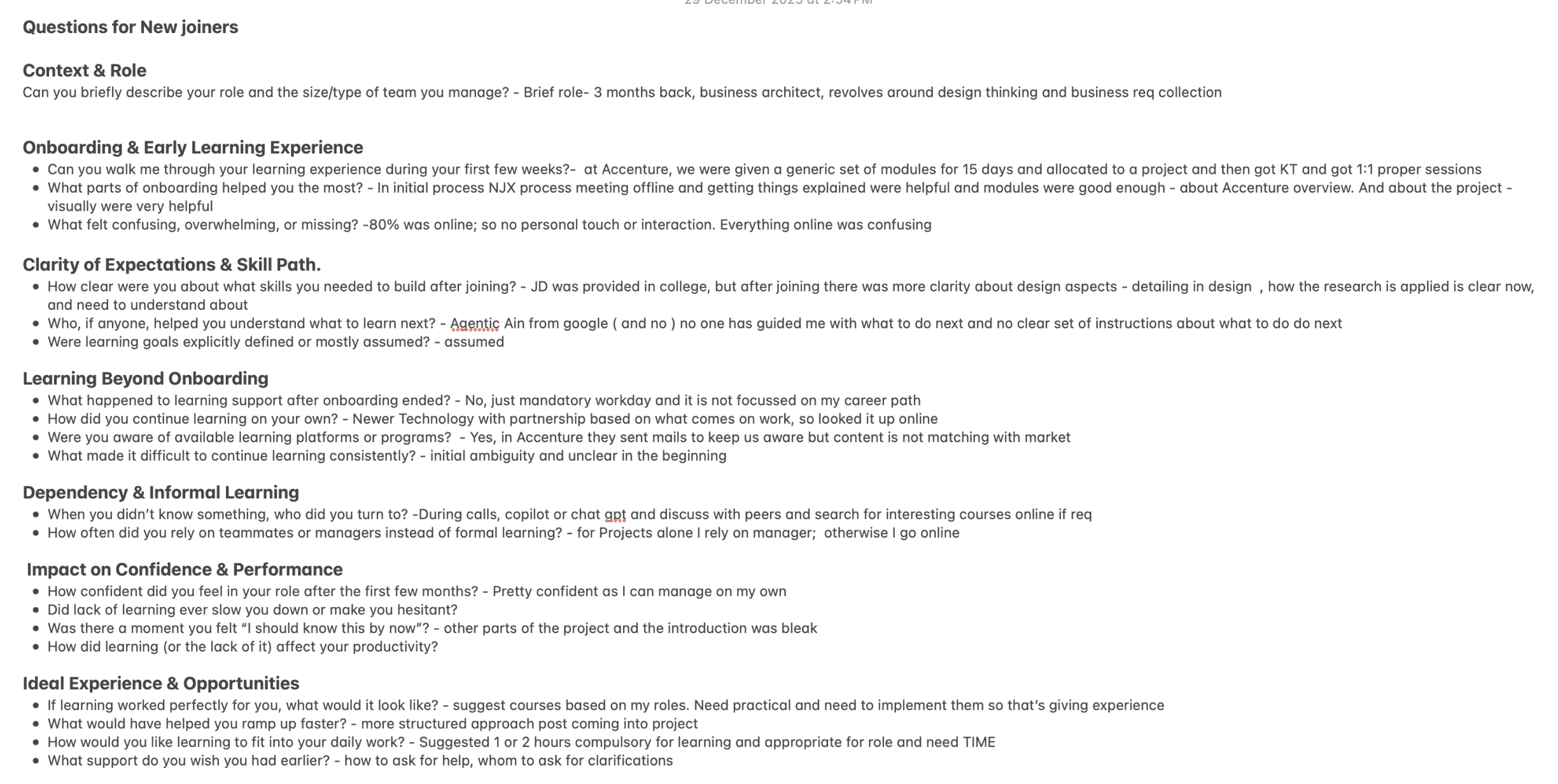
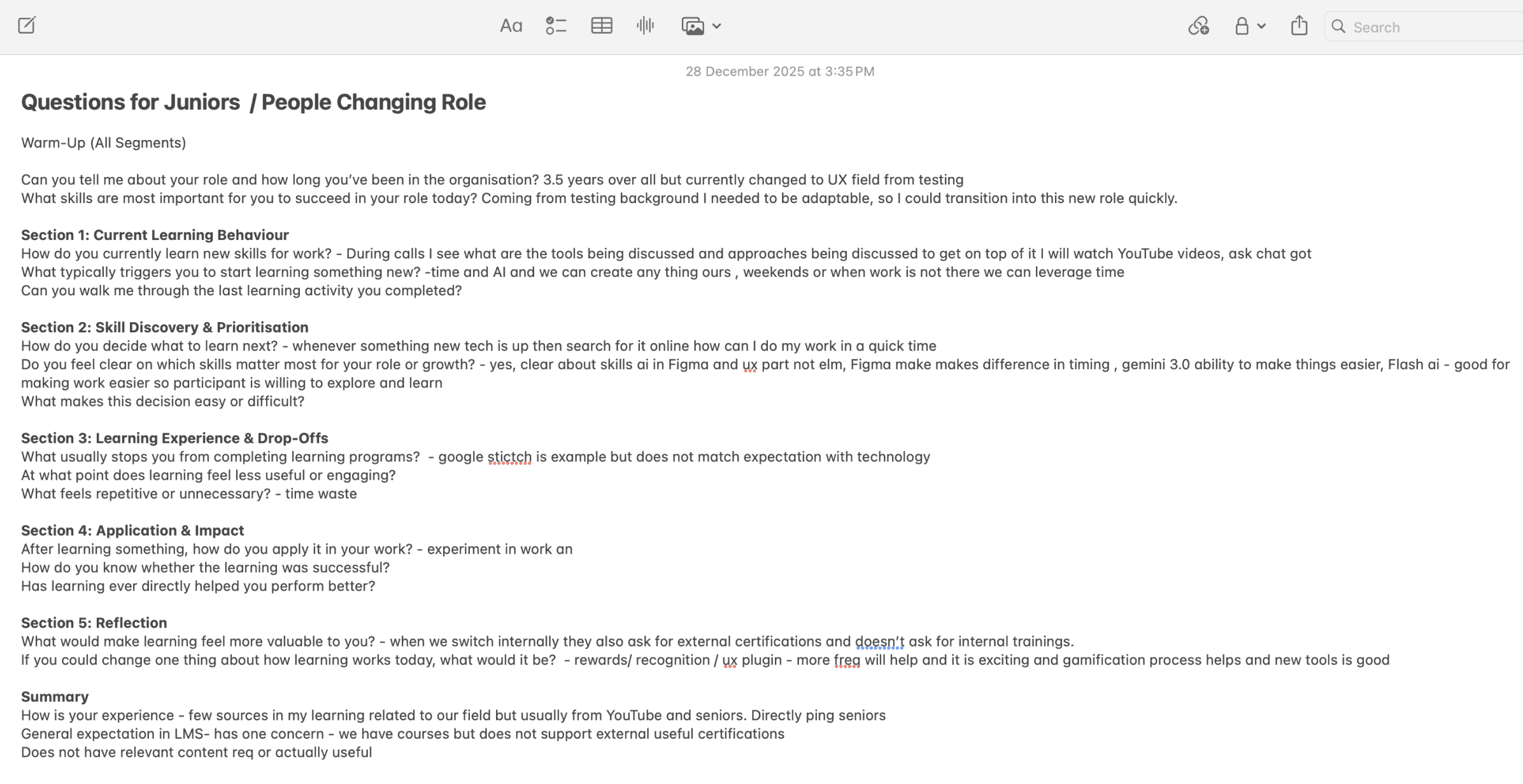
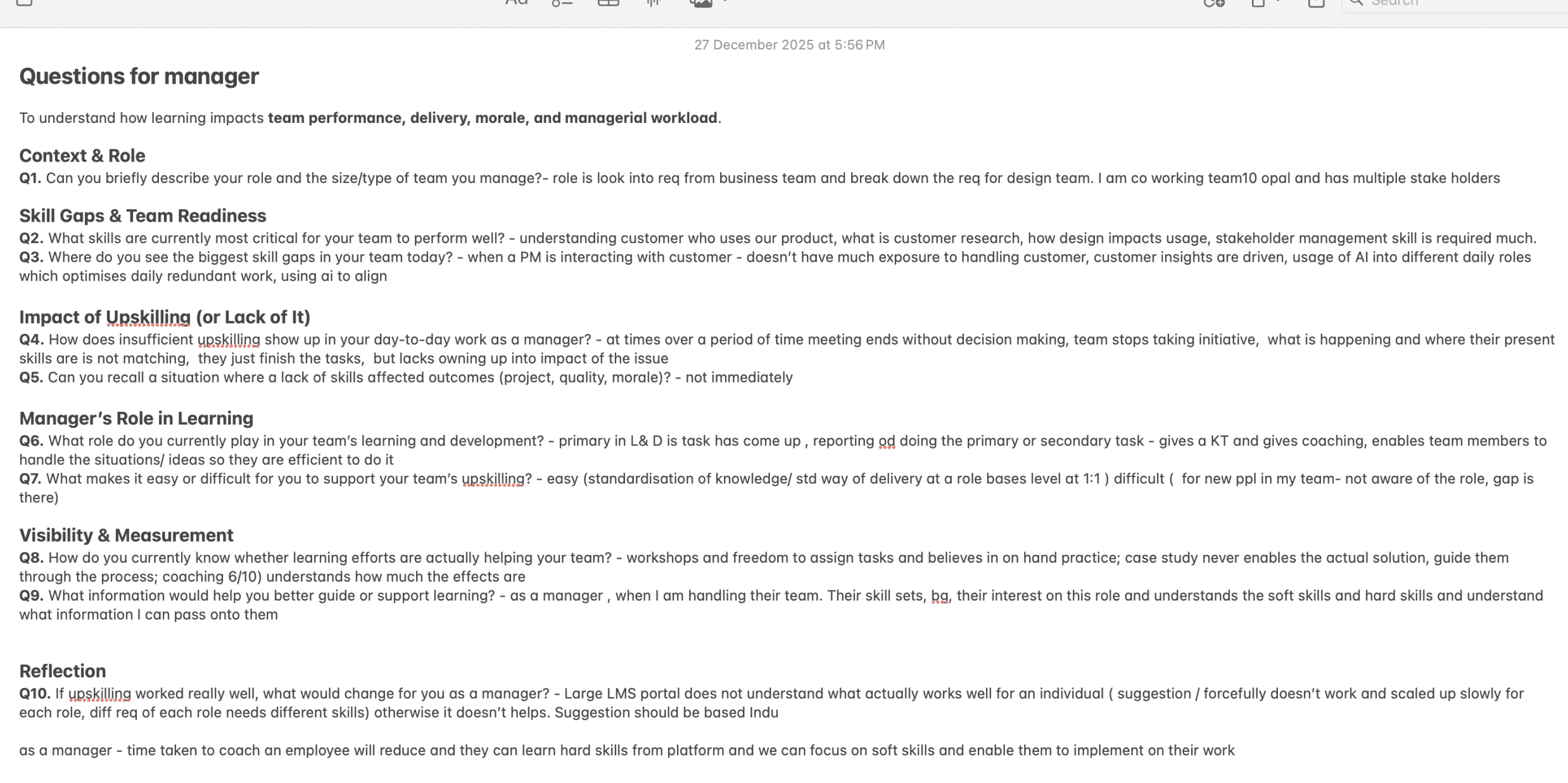
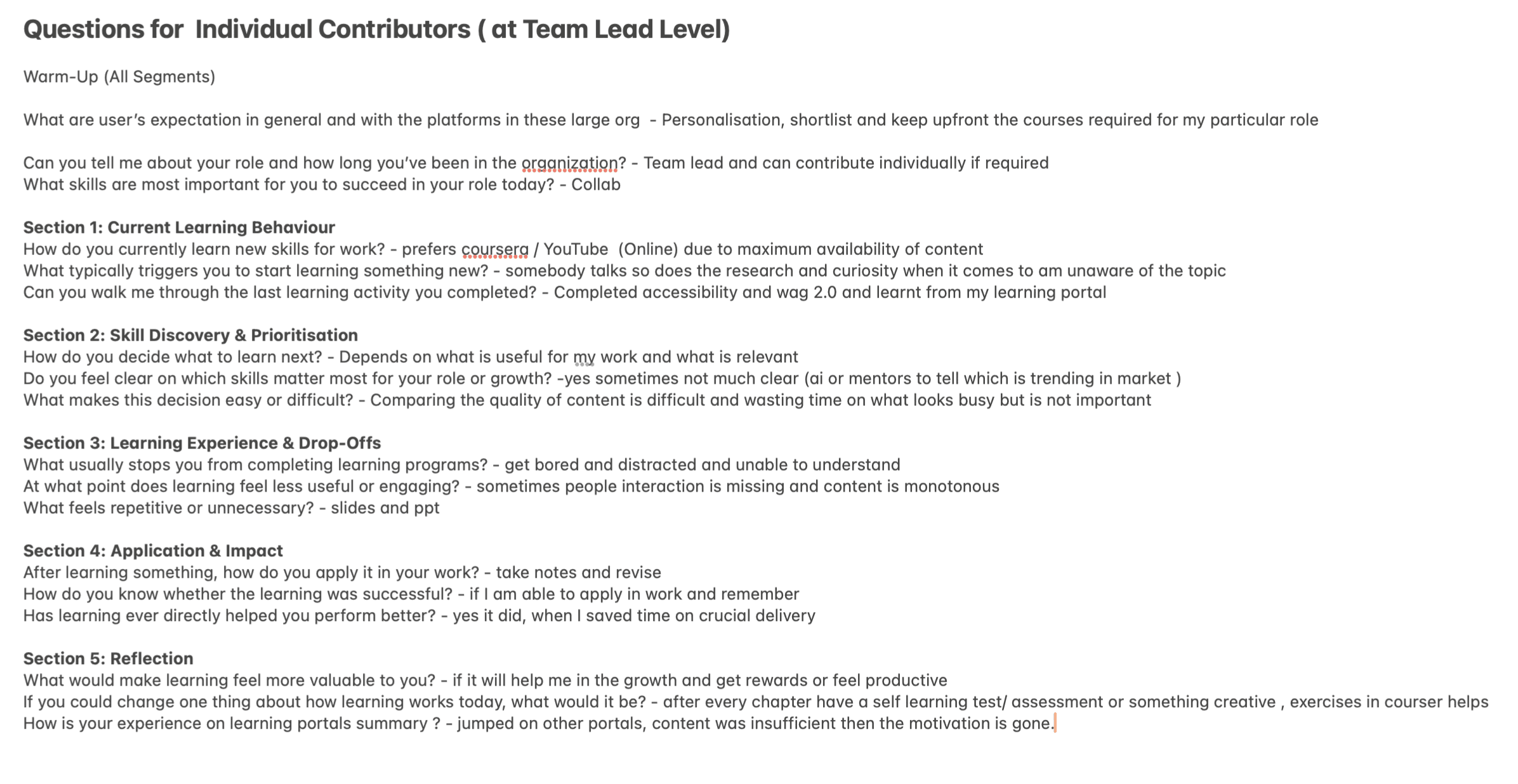
Questions for User’s & Data Collected
Research
Debrief
The research focused on understanding behaviors, motivations, constraints, and role-specific influences on learning.
The goal was to identify gaps between organisational intent and on-ground reality, and to uncover systemic barriers that prevent continuous skill development across roles. To capture diverse perspectives, the study included managers, team leads, individual contributors, and one participant who recently transitioned roles.
Key Findings
Pain Points
Irrelevant Content
68% of users found courses not aligned with their job needs
No Career Connection
82% couldn't see how learning impacted career progression
Time Constraints
75% struggled to find time for learning during work hours
Unrelated Topics do not contribute to real-time execution
60% felt learning is not related to execution in project
Opportunities
Personalization
Users want AI-driven recommendations based on their role
Social Learning
89% valued peer learning and knowledge sharing
Microlearning
Short, focused content preferred over lengthy courses
Progress Tracking
Desire to visualize skill growth and achievements
Persona’s
Below are 3 key persona’s - fictional, semi-realistic representation of a target audience based on research & data with demographics, behaviours, pain points & needs
“I can only scale my responsibilities if I’m confident my team is truly ready —not just trained.”
Ankit is a people manager with 10 + years of experience, who is responsible for balancing delivery commitments with long-term team growth. He is accountable for outcomes but often lacks clear visibility into whether learning efforts have translated into real capability.
Pain Points:
Lack of clear indicators of employee readiness
Forced to assume capability under time pressure
Learning outcomes are not visible or measurable
Over-focus on hard skills at the cost of leadership and soft skills
Goals:
Ensure delivery commitments are met without constant escalations
Build a reliable, capable team that can scale
Make confident decisions around readiness, promotions, and role fit
Personality Traits:
Outcome-driven
Risk-aware
Pragmatic
Time-constrained
Ankit Sharma
Role:
People Manager
Title:
Management Consulting Manager
Age:
36

“There’s a lot of information, but I don’t know who to go to or what actually matters right now.”
Neha has recently joined the organization and is navigating onboarding, learning systems, and informal support structures. While learning content is available, a lack of clarity around ownership, expectations, and feedback makes it difficult for her to build confidence early on.
Pain Points:
Receives inconsistent or delayed feedback regarding the role in project(reactive) post a delivery
Learns through trial and error and reaches out to peers due to unclear guidance
Learning portals offer generic content not mapped to their actual role or project
Lack of curated, role-specific course recommendations
Goals:
Use multiple learning sources to close immediate skill gaps(Must have vs nice to have skills)
Identify role-aligned learning paths instead of generic onboarding courses
Understand the project context, business background, and expectations they are assigned to
Personality Traits:
Eager to learn
Overwhelmed
Cautious
Unsure
Neha Rao
Role:
New Joiner
Title:
Engineering Analyst
Age:
24

“I’m expected to deliver quickly, but the learning doesn’t fully prepare me for the role.”
Ashok is an experienced individual contributor who has transitioned into a new role internally. He is expected to demonstrate readiness quickly but finds that internal learning content is vague, fragmented, and misaligned with industry and role-specific expectations.
Pain Points:
Internal learning content feels vague or misaligned with role demands
Needs to navigate multiple learning sources without clear guidance
Lacks access to industry-aligned or credible certifications internally
No clear benchmarks to assess readiness
Goals:
Quickly identify and consume learning relevant to the new role
Use multiple learning sources to close immediate skill gaps
Meet performance expectations within defined transition timelines
Establish credibility in the new role to prove readiness
Personality Traits:
Credibility Conscious
Driven
Growth Oriented
Skill Builder
Ashok Goyal
Role:
Individual Contributor
Title:
Business Arch Senior Analyst
Age:
28

Empathy
Map
To deepen understanding beyond surface-level behaviours, empathy maps were created for each key persona identified during research. These maps synthesise patterns observed across interviews, capturing what employees think, feel, say, and do as they navigate learning and skill-building within the organisation.
By visualising emotional drivers, constraints, and unmet needs, the empathy maps help reveal why existing learning experiences feel disconnected from real work and growth
External - Says and does (observable)
Internal - Thinks and feels (inferred , invisible)
Empathy Maps
Defers soft-skill development
The
Manager
Says
Does
Thinks
Feels
Frustrated by recurring escalations
Mentally overloaded about deciding readiness
“I need to make people decisions with incomplete data.”
Assigns tasks based on perceived readiness
Pushes short-term hard-skill learning for the team
Relies on assumptions,experience and instinct over data
“My team’s capability defines my delivery success.”
“Who is genuinely ready vs just busy learning?”
“I don’t have visibility into learning outcomes.”
“I cannot trust team with stakeholder management.”
Accountable for both delivery and growth
“Focus on delivery first.”
“Let’s upskill them on what’s immediately required.”
“Tell me when you’re ready.”
“We’ll revisit growth once things stabilize.”
“Let me know if you need support.”
Pressured by timelines and client expectations
As-Is
Journey Map
The As-Is Journey Maps capture how learning and skill-building currently unfold across key moments in an employee’s lifecycle, highlighting dependencies, delays, and decision gaps that impact readiness, confidence, and delivery.
The Manager and the policy makers are not as a "student" of the platform, but the Governor of the team's time.
Policy Maker is focused on Annual ROI and Workforce Capability.
These pinpoint when and where breakdowns occur by decoding the experience of what is happening right now
As- Is
Journey Map
Scenario: A high-performing Individual Contributor (IC) is promoted to Team Lead.
Role: Recently
Promoted
Goal: Prove capability and master new leadership skills quickly.

Promotion
Week 1
Week 2-4
Months 2-3
Months 6
Thoughts
Emotions
Pain Points
Opportunities
Actions
Content Crush
Delivery Trap
Stale Plateau
Celebrates, declares goals; then looks for "How to Lead" resources and beings with Mandatory trainings
Attempts to complete 15+ "Generic Leadership" videos; bookmarks 20+ PDFs.
Closes the L&D tab to answer urgent Slack pings; "wings it" during team meetings. Project work pressure hits; skips learning to meet deadline.
Scrambles to find an external industry certification to prove they aren't "stale."
"I can't wait to make an impact!"
Lack of a clear "Skill Roadmap"
No "safe-failure" zone to practice new skills
No signals of readiness or industry-standard alignment.
Content/Role Mismatch.
"None of this tells me how to handle my specific team."
"I'll learn this later; I need to survive this week."
"My skills are becoming stale; i just realised I'm only winging it."
Replace the "Firehose Content/ Content Dump" with a 30/60/90 day curated path tied to role milestones.
Insight 1:
Integrate Industry Standard Certifications directly into the internal growth path to prevent "stale" profiles.
Insight 2:
Problem
Statement
Main Problem statement and supportive statements throwing light on what is broken and why it matters
Problem statements translate observed behaviors, emotional tensions, and systemic gaps into actionable design challenges. Instead of jumping to solutions, this step ensures we anchor on the real user struggle, the root cause behind it, and the impact on both the user and the business.
Employees across roles are learners at different career stages
who need role-relevant learning to become delivery-ready but face generic, compliance-driven learning
because learning is designed around completion metrics rather than role readiness or safe learning experimentation.
This results in low confidence, delayed productivity, and unclear ROI on learning investments.
The "Safety- Net" Gap (User Perspective)
Individual Contributors and Transtioners are professionals navigating role growth who need need a way to identify and fix skill gaps, but they are hesitant to have open conversations about their weaknesses for fear of appearing incompetent
because learning systems lack structure, depth and safe learning experimentation.
This results in users "winging it" during high-stakes delivery, leading to preventable mistakes and increased imposter syndrome.
The "Stale Growth" Gap (Organisation/Market/Policy Perspective)
Employees need industry-relevant skill growth to remain competitive but face a disconnect between internal training and evolving industry standards because internal L&D programs are not aligned with externally recognised skills or certifications.
This results in employees perceiving their growth as stagnant, seeking learning outside the organisation on external platforms like Udemy/ Coursera.
The Visibility Gap (Manager Perspective)
Managers are people leaders and in-charge of delivery
who need a clear way to assess team capability before delegating tasks, but they currently lack visibility into real-time skill levels because the system only tracks course completion.
This results in managers micromanaging hard skills and sacrificing their own stakeholder management time to fix "remedial" errors.
Overarching
HMW
Overarching HMW questions unify multiple HMWs into one direction
It encompasses multiple personas connecting multiple pain points and acts as a north star for the entire initiative guiding long term decisions
How might we enable role-ready, industry-aligned learning
for employees across career stages
in order to drive measurable capability, professional growth, and business impact?
Key Decisions - Value proposition
Role-Relevant Learning
Moves beyond generic modules to provide "Tribal Knowledge" and project-specific intelligence.
Replaces hours of aimless searching
Applied Learning with Safe-Failure Sandbox
A private simulation zone where transtioners can practice high-stakes executions with AI feedback before performing live.
Identifies blind spots in private
Project Portal
Relevant project files and context specific understandings and trainings to grow within Project
Reduces hours of mundane searching for relevant skills and project understanding
Micro-Learning Focus
Broke down lengthy courses into 5-15 minute modules that fit into busy schedules. Users can learn during coffee breaks.
On the go for busy schedule individuals
L&D Proposed Ecosystem
LearnHub Core
Central learning platform
Learning Paths
Skill Tracking
Safe Sandbox
MS Teams
Team readiness & collaboration
Skill Dashboard
Team Analytics
Learning Reminders
Jira
Skill-based task assignment
Auto Assignment
Skill Matching
Gap Alerts
Integration Flow
LearnHub
Teams Bot
Jira API
Certifications
Wireframes
A basic sketch was done to navigate through the initial design process. Helped in understanding the main functionalities & screens that play a big role while prototyping.
Detailed wireframes showcasing key features: safe sandbox environment, dual dashboards, quick learnings, and project-based training.
1. Employee Dashboard
Personalized learning hub with recommended courses, progress tracking, and quick access to sandbox practice areas.
Dashboard
My Learning
Sandbox
Projects
Quick Learns
Career Path
42%
12
5h
8
2. Manager Dashboard
Comprehensive view of team learning progress, skill gaps, and training recommendations with actionable insights.
Team View
Overview
Team Analytics
Skill Matrix
Assign Training
Reports
Team Size
24
Avg Progress
68%
Skills Gap
12
This Week
142h
3. Safe Sandbox Environment
Isolated practice environment where employees can experiment, learn by doing, and make mistakes safely without affecting production systems.
SANDBOX MODE
1
2
3
API
Database
Frontend
Auth
main.js
app.js
+
Run
Reset
Save
Preview
Console
✓
4. Quick Learning Module
Micro-learning interface for 5-15 minute learning sessions that fit into busy schedules, with progress tracking and immediate application.
5 min
3 of 5
Point 1
Point 2
Point 3
← Previous
Next →
Save Note
Open Sandbox
5. Project Files & Training Portal
Centralized hub for project-specific resources, documentation, and contextual training materials organized by active projects.
Search...
/
/
▼
▶
▶
Files
Training
Resources
Team
XLSX
▶
VIDEO
12m
PPTX
TRAINING
8m
DOCX
View All
Wireframe
Feedback
The goal of this feedback was to assess clarity, relevance, confidence, and decision-making support within the experience.
These 1:1 conversations allowed for deeper probing, follow-up questions, and contextual understanding—especially around how users currently make learning decisions and how the proposed experience would fit into their real workflows.
Key Insights
Breaking L&D Portals 4th wall and integrating it with existing applications(Teams and Jira)Keeping in mind that Teams serves as the always-available entry point for quick learning queries, while the portal supports deeper learning needs. At the same time, Jira surfaces employee readiness signals, allowing managers to assign work based on skill readiness.
Managers need a clear separation between viewing their team’s capability and assessing their own growth readiness. The dashboard experience is therefore intentionally segmented—allowing managers to evaluate team capacity independently from reflecting on their personal development and alignment for future responsibilities.
Integrating externally recognized certifications (industry platforms, vendors, professional bodies) using API’s into the internal L&D portal allows employees to translate personal learning effort into organizationally visible growth signals and reducing bias-driven or inconsistent growth outcomes.
An Expert Node / Mentor layer within the Project Knowledge Atlas gives new joiners a clear, human entry point into complex project contexts. Instead of navigating fragmented documents or guessing whom to approach, new joiners can identify verified experts tied to specific domains, decisions, or project phases. This reduces hesitation, accelerates onboarding, and builds confidence by allowing them to ask context-aware questions and validate their understanding early.
While retaining mandatory compliance requirements, the portal is designed to actively support and enable employee growth and transition new joiners seamlessly into their projects and roles.
Next Steps & Future Enhancements
Planned Features
AI-powered learning assistant for personalized coaching
Integration with performance review systems
Enhanced social features including live learning sessions
Mobile app for on-the-go learning
Expansion Plans
Rolling out to 10 additional organizations in Q2
Developing industry-specific content libraries
Building partnerships with leading course providers
Exploring international markets and localization